This post contains affiliate links.
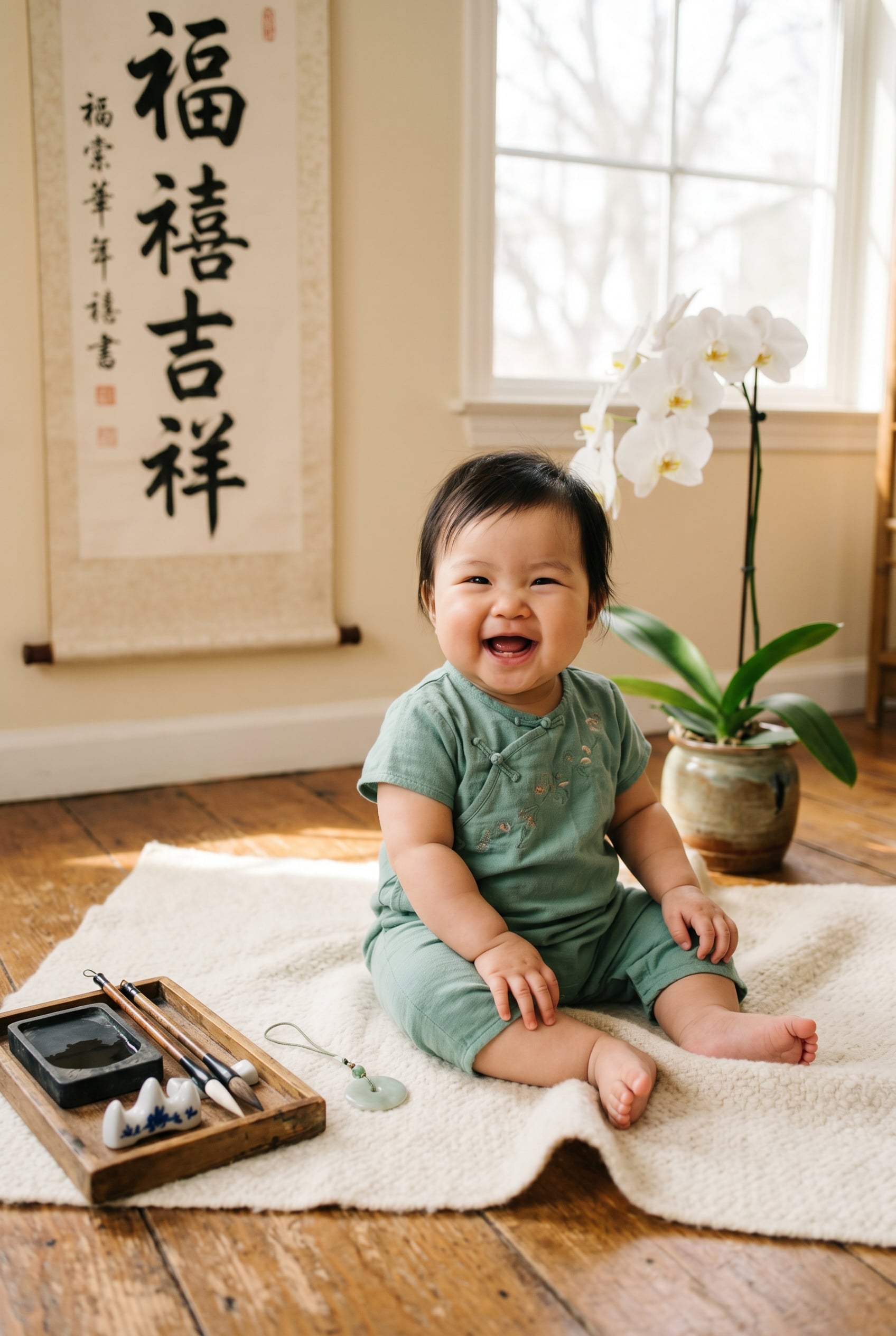
Chinese names work differently than most Western ones: instead of picking a name off a list, parents choose or combine individual characters, each carrying its own sound, history, and meaning. Two characters that sound exactly alike on paper can mean “morning light” or “brilliant fire” — the pronunciation is only half the story. That’s why this list isn’t really about finding a name that sounds nice; it’s about finding the right characters, the ones whose meaning you’d want your child to carry.
🔍 Curious how popular a name is?
Check any name's popularity trend since 1880 with our free Baby Name Popularity Checker.
Popularity below is calculated from Social Security Administration data through 2024, the most recent year on record.
Here’s what’s in store –

Names That Mean Light, Brightness, and Radiance
Names Drawn from Nature — Flowers, Water, and Sky
Girls’ Names for Grace, Joy, and Inner Virtue
Boys’ Names for Power, Ambition, and Vision
Classical and Literary Names With Deep Roots
Names Meaning Peace, Harmony, and Calm
What makes Chinese names so rich is the layering. Most modern Chinese names use one or two characters after the family name, and those one or two characters do serious work: they evoke nature, philosophy, classical literature, personal aspiration, and family lineage simultaneously. A grandmother might recognize a character from a Tang dynasty poem. A child might grow into the meaning of their name the way you grow into a piece of furniture that was slightly too big when you bought it.
This list gathers 200+ real Chinese names — single characters and two-character combinations — organized by theme and feeling rather than alphabetically. Each name includes its pinyin romanization, the character’s meaning, and a note on its cultural weight or contemporary use. Whether you’re looking for a name for a Chinese-heritage baby, a name that honors a specific lineage, or simply a name with a sound and meaning unlike anything in the Western canon, this is a starting place.
A note on romanization: pinyin is the standard system for spelling Chinese sounds in Latin letters. Tones matter enormously in Mandarin (the same syllable in different tones means completely different things), but for written purposes here, we’re following the standard pinyin without tone marks since most name registrations in English-speaking countries drop them.
Names That Mean Light, Brightness, and Radiance
Light is one of the most beloved themes in Chinese baby naming — it speaks to hope, intelligence, and illuminated futures. These names use characters that evoke everything from flickering candlelight to the full blaze of the sun.
- Origin: Chinese
- Pronunciation: MING · ˈmɪŋ
- Meaning: bright, brilliant
- Popularity: #9,549 and rising (#11,824 → #9,549, 2024)
- Origin: Mandarin (romanizes 回 ‘Hui ethnicity’, 徽, or 惠 ‘gracious’, among others, character-dependent)
- Pronunciation: HWAY · hweɪ
- Meaning: Intelligent, brilliantly bright
- Popularity: Not in the U.S. Social Security rankings
More than just smart — this character implies a kind of luminous inner wisdom that shines outward.
- Origin: Chinese
- Pronunciation: JING · ˈdʒɪŋ
- Meaning: Crystal clear, sparkling like gemstone
- Popularity: #11,538 and falling (#11,515 → #11,538, 2024)
Often used in girls’ names; the character shows three suns stacked, which visually says everything about its radiance.
- Origin: Chinese (Mandarin pinyin, meaning depends on the character used)
- Pronunciation: SHYAH · ˈʃjɑː
- Meaning: Rosy clouds at sunrise or sunset
- Popularity: #5,125 and falling (#5,116 → #5,125, 2024)
One of the most poetic light characters, evoking the way sky glows at the edges of the day.
- Origin: Vietnamese (given name, from Cần)
- Pronunciation: KUHN · kən
- Meaning: Dazzling, brilliant
- Popularity: #4,324 and rising (#4,904 → #4,324, 2024)
Usually paired in two-character names; alone it carries an almost excessive brightness — like something that stops you mid-sentence.
- Origin: Chinese
- Pronunciation: WAY · ˈweɪ
- Meaning: great, impressive
- Popularity: #9,637 as of 2017 — not currently in the U.S. Social Security rankings
Warmer and more amber than the cold shimmer of Jing; popular in boys’ names.
- Origin: Chinese (Mandarin pinyin romanization)
- Pronunciation: HOW · ˈhaʊ
- Meaning: represents several distinct Chinese characters (e.g. 浩 ‘vast’, 昊 ‘vast sky’, 豪 ‘heroic, grand’); the meaning depends on which character is used
- Popularity: #12,796 as of 2021 — not currently in the U.S. Social Security rankings
- Origin: Mandarin Chinese (ambiguous, common surname/given-name romanization)
- Pronunciation: LYAHNG
- Meaning: often intended as ‘bright,’ though this isn’t confirmed by the available source
- Popularity: Not in the U.S. Social Security rankings
Unpretentious and strong; this character means what it says without flourish.
- Origin: Chinese (character-dependent, no given-name-specific entry found)
- Pronunciation: YWEH · ˈjweɪ
- Meaning: Radiant celestial body, dazzling
- Popularity: #8,387 and rising (#12,138 → #8,387, 2024)
Used for heavenly objects that shine — sun, moon, stars; a name that reaches upward.
- Origin: Mandarin (Chinese surname/historical place name)
- Pronunciation: YEENG · iŋ
- Meaning: a historical Chinese surname and place name (including the ruling clan name of the Qin dynasty)
- Popularity: #17,230 as of 2009 — not currently in the U.S. Social Security rankings
The glow from within rather than the blaze from without; associated with the particular sheen of fine green jade.
- Origin: Old Occitan/Asturian (variant of John); also a common Mandarin romanization
- Pronunciation: SWUN · swən
- Meaning: God is gracious (as a variant of the name John); as a Chinese name, the meaning depends on the character it represents
- Popularity: #13,730 as of 2019 — not currently in the U.S. Social Security rankings
Less common than other light characters, which gives it a distinctive, slightly mysterious feel.
- Origin: Portuguese; Japanese; Chinese (three distinct, unrelated origins)
- Pronunciation: RWAY · ˈrweɪ
- Meaning: Wise and farsighted, illuminated mind
- Popularity: #2,297 and rising (#2,763 → #2,297, 2024)
Popular in contemporary Chinese naming; the character implies a brightness that sees further than ordinary intelligence.
- Origin: Mandarin (surname / ancient place name)
- Pronunciation: JOW · dʒaʊ
- Meaning: Brilliant, illustrious
- Popularity: Not in the U.S. Social Security rankings
Classical and dignified; Zhao Jun was a famous Han dynasty beauty whose name became part of Chinese cultural vocabulary.
- Origin: Mandarin
- Pronunciation: JWOH · dʒwɔː
- Meaning: outstanding and eminent
- Popularity: Not in the U.S. Social Security rankings
Used in both male and female names; the character suggests a kind of elevated brightness.
- Origin: Mandarin (Chinese given name)
- Pronunciation: how-YOO · xaʊ.y
- Meaning: Luminous universe
- Popularity: Not in the U.S. Social Security rankings
A two-character name combining white radiance with the infinite cosmos; currently popular for boys in mainland China.
- Origin: Mandarin Chinese
- Pronunciation: tsahn-HWAY · tsʰan.xweɪ
- Meaning: Brilliantly wise
- Popularity: Not in the U.S. Social Security rankings
- Origin: Mandarin (Chinese given name)
- Pronunciation: jeeng-MEENG · dʒɪŋmɪŋ
- Meaning: Crystal-clear brightness
- Popularity: Not in the U.S. Social Security rankings
Doubled brightness; a name that communicates translucent clarity of mind and spirit.
- Origin: Mandarin Chinese
- Pronunciation: MING-joo
- Meaning: bright pearl, an idiom also used affectionately for a cherished daughter
- Popularity: Not in the U.S. Social Security rankings
A classic and beloved combination; pearls are culturally precious in ways that overlap with the Western tradition.
- Origin: Mandarin Chinese
- Pronunciation: MING-shyah · miŋ̌.ɕjâ
- Meaning: bright, paired with the rosy glow of sunrise or sunset clouds (明 + 霞)
- Popularity: Not in the U.S. Social Security rankings
Poetic and feminine, combining the clarity of Ming with the warm glow of dawn or dusk light.
- Origin: Mandarin (Chinese given name)
- Pronunciation: SHWEN-yee · ɕɥɛ́n.í
- Meaning: Brilliant and artistically gifted
- Popularity: Not in the U.S. Social Security rankings
A contemporary-feeling name that marries radiance with creative skill.
- Origin: Mandarin Chinese
- Pronunciation: tsahn-RAY · tsʰan.ʐweɪ
- Meaning: Brilliantly wise and farsighted
- Popularity: Not in the U.S. Social Security rankings
A strong pairing for boys; combines two distinct kinds of brightness — visible and intellectual.
- Origin: Mandarin (Chinese given name)
- Pronunciation: YING-ying · jɪŋ.jɪŋ
- Meaning: Doubly lustrous, twice jade-bright
- Popularity: Not in the U.S. Social Security rankings
Reduplicated names like this carry affectionate softness; historically used as milk names (pet names) for girls.
- Origin: Mandarin
- Pronunciation: JUH · dʒʌ
- Meaning: wise and philosophical
- Popularity: Not in the U.S. Social Security rankings
Bridges brightness and wisdom; a scholar’s name with old bones.
- Origin: Mandarin (Chinese given name)
- Pronunciation: GWANG-rway · ɡwɑːŋˈʐweɪ
- Meaning: Auspiciously bright, glowing omen
- Popularity: Not in the U.S. Social Security rankings
The combination of light and blessing makes this a name families choose when they want a name that announces good fortune.
Names Drawn from Nature — Flowers, Water, and Sky
Chinese literary and naming traditions are deeply rooted in the natural world. Mountains, rivers, seasonal flowers, and weather phenomena appear throughout classical poetry, and they translate beautifully into names that feel alive and grounded.
- Origin: Chinese (Mandarin)
- Pronunciation: MAY · ˈmeɪ
- Meaning: beautiful
- Popularity: #1,960 and rising (#2,325 → #1,960, 2024)
The ‘plum blossom’ half is a mix-up: it belongs to a separate, similarly-sounding character (梅) used mostly as a surname, not the root of the given name, which is 美 (‘beautiful’).
- Origin: Vietnamese (also used in Chinese contexts)
- Pronunciation: LAHN · ˈlɑːn
- Meaning: orchid
- Popularity: #8,670 and rising (#13,349 → #8,670, 2024)
Orchids represent nobility, purity, and friendship in Chinese culture — the four noble plants (with plum, bamboo, and chrysanthemum) anchor classical Chinese aesthetics.
- Origin: Chinese
- Pronunciation: lee-AHN · liˈɑːn
- Meaning: lotus or water lily
- Popularity: #514 and rising (#584 → #514, 2024)
Rises from muddy water to bloom clean and pure; a name about transformation and inner virtue that dates back thousands of years.
- Origin: Mandarin Chinese (pinyin, underlying character uncertain)
- Pronunciation: JYOO · tɕy
- Meaning: possibly ‘chrysanthemum’
- Popularity: Not in the U.S. Social Security rankings
Blooms in autumn when everything else is dying — a symbol of longevity, resilience, and a refusal to fade easily.
- Origin: Chinese (meaning depends on the character used)
- Pronunciation: HUH · xɤ
- Meaning: depends on the character: a surname (何, no independent meaning), “harmony/peace” (和), or “lotus” (荷)
- Popularity: Not in the U.S. Social Security rankings
A softer character for lotus than Lian; carries more of the water and stillness than the upward-reaching aspiration.
- Origin: Mandarin (historical surname 媯, distinct from the osmanthus sense 桂)
- Pronunciation: GWAY · ɡweɪ
- Meaning: Osmanthus blossom
- Popularity: Not in the U.S. Social Security rankings
The sweet-scented osmanthus blooms in autumn and is closely associated with the moon; a name of quiet, intoxicating beauty.
- Origin: Chinese
- Pronunciation: FUNG · fəŋ
- Meaning: depends on the character used — options include ‘phoenix,’ an old place name/surname, or (with a different character) ‘maple’
- Popularity: Not in the U.S. Social Security rankings
Autumn maple leaves burning red and orange; a name with fire in its nature, unexpected and vivid.
- Origin: Mandarin
- Pronunciation: JOO · dʒuː
- Meaning: bamboo
- Popularity: Not in the U.S. Social Security rankings
- Origin: Mandarin
- Meaning: name of a major Chinese imperial dynasty (960-1279 AD)
- Popularity: #13,912 and falling (#10,595 → #13,912, 2024)
The ‘pine tree’ meaning belongs to a different character pronounced the same way (松) — Song is best attested as the name of a major Chinese imperial dynasty.
- Origin: Chinese (Mandarin)
- Pronunciation: TOW · ˈtaʊ
- Meaning: the Way, the path (Taoist concept, from 道 dào)
- Popularity: #9,733 and falling (#7,246 → #9,733, 2024)
In Chinese mythology, the peach is the fruit of immortality; Tao gardens appear throughout Daoist stories as paradise.
- Origin: Mandarin (shared by unrelated Chinese characters)
- Pronunciation: CHYEN · tʃjɛn
- Meaning: Lush, dense green growth
- Popularity: Not in the U.S. Social Security rankings
Evokes a field of thick grass or abundant young plants; a name that feels fresh and generative.
- Origin: Chinese (Mandarin pinyin romanization)
- Pronunciation: RAWNG · ˈrɔːŋ
- Meaning: Lotus flower, hibiscus
- Popularity: Not in the U.S. Social Security rankings
More relaxed than Lian; widely used in girls’ names across the 20th century and still carried elegantly by contemporary bearers.
- Origin: Chinese (Mandarin pinyin, represents multiple distinct characters)
- Pronunciation: SHIN · ɕin
- Meaning: Heart of a flower, essential core
- Popularity: #17,480 as of 2023 — not currently in the U.S. Social Security rankings
The innermost part; a name about the concentrated essence of something — not the bloom but the seed at its center.
- Origin: Mandarin Chinese
- Pronunciation: BYE-huh · baɪ.xɤ
- Meaning: Lily — literally “hundred unities”
- Popularity: Not in the U.S. Social Security rankings
A name whose characters carry more meaning than the flower alone; it speaks to wholeness and many things coming together.
- Origin: Mandarin Chinese
- Pronunciation: may-LAHN · meɪˈlɑːn
- Meaning: beautiful orchid
- Popularity: Not in the U.S. Social Security rankings
A classic pairing of two noble flowers; Mei Lanfang, the legendary Peking opera performer, made this combination famous.
- Origin: Mandarin
- Pronunciation: yoo-LYAHN · ɥ.ljɛn
- Meaning: jade and lotus blossom
- Popularity: #2,360 and rising (#2,608 → #2,360, 2024)
Combines two of the most esteemed natural symbols in Chinese culture; a formal name with genuine grace.
- Origin: Mandarin (Chinese given name)
- Pronunciation: hahn-MAY · xæn.meɪ
- Meaning: Cold-weather plum, winter plum
- Popularity: Not in the U.S. Social Security rankings
Specifically the plum that blooms in frost — a name about beauty that appears precisely where you least expect it.
- Origin: Chinese (Mandarin)
- Pronunciation: choon-HWAH · tʃʊnhwɑː
- Meaning: Spring flower
- Popularity: Not in the U.S. Social Security rankings
Warm and unambiguous; a name that puts a whole season’s promise into two simple characters.
- Origin: Mandarin (specific characters uncertain)
- Pronunciation: shahn-HOO · ʂɑn.xu
- Meaning: Coral
- Popularity: Not in the U.S. Social Security rankings
Rare and precious; coral was historically considered one of the seven Buddhist treasures and appears in poetry as a symbol of refined beauty.
- Origin: Mandarin
- Pronunciation: joo-YOON · dʒuːˈjuːn
- Meaning: bamboo and cloud
- Popularity: Not in the U.S. Social Security rankings
- Origin: Mandarin
- Pronunciation: tyen-HUH · tjɛn.xɤ
- Meaning: the Milky Way, literally ‘heaven’s river’
- Popularity: Not in the U.S. Social Security rankings
- Origin: Mandarin
- Pronunciation: YOON-shahn · jynˈʃɑːn
- Meaning: cloud-wreathed mountains
- Popularity: Not in the U.S. Social Security rankings
The classical Chinese landscape scroll in two characters; a name with vast visual imagination built in.
- Origin: Mandarin
- Pronunciation: ching-HUH · tɕʰiŋ.xɤ
- Meaning: combines the words for ‘blue-green’ and ‘river’; also used as a Chinese place name
- Popularity: Not in the U.S. Social Security rankings
Combines purity with the lotus’s particular grace; sounds cool and clean aloud.
- Origin: Mandarin (Chinese given name)
- Pronunciation: fung-LING · fəŋˈlɪŋ
- Meaning: Maple spirit
- Popularity: Not in the U.S. Social Security rankings
A slightly more magical reading of the maple; less common and more poetic than Feng alone.
- Origin: Mandarin (Chinese given name)
- Pronunciation: SHWEH-ying · ɕɥɛ́.íŋ
- Meaning: Snow-lustrous, gleaming like snow
- Popularity: Not in the U.S. Social Security rankings
The cool brightness of snow paired with the jade-glow of Ying; a winter name for a baby who arrives in the cold months.
- Origin: Mandarin (Chinese given name)
- Pronunciation: HY-bwoh · haɪ.bwoʊ
- Meaning: Ocean waves
- Popularity: Not in the U.S. Social Security rankings
Large and rhythmic; a name with the expansiveness of open water.
- Origin: Mandarin Chinese
- Pronunciation: LYOH-ying · ljoʊˈjɪŋ
- Meaning: willow tree paired with oriole, a classical poetic image pairing
- Popularity: Not in the U.S. Social Security rankings
A compound from classical poetry — the image of a yellow bird singing in weeping willow branches on a spring morning is one of Chinese literature’s sweetest pictures.
- Origin: Mandarin Chinese
- Pronunciation: LING-huh · lɪŋ.xɤ
- Meaning: spirit/soul paired with lotus (likely 灵 + 荷)
- Popularity: Not in the U.S. Social Security rankings
Adds a layer of sacred or otherworldly quality to the lotus; a name for a child you feel has arrived with something special about them.
- Origin: Mandarin (Chinese given name)
- Pronunciation: hahn-SHWEH · xæn.ɕy̯ɛ
- Meaning: Cold snow
- Popularity: Not in the U.S. Social Security rankings
A name about austere beauty; not immediately warm but breathtaking in the right light.
- Origin: Chinese (Mandarin)
- Pronunciation: zuh-YOON
- Meaning: purple cloud
- Popularity: Not in the U.S. Social Security rankings
Purple clouds were considered auspicious omens in Chinese cosmology — a sign that something blessed was about to arrive.
Girls’ Names for Grace, Joy, and Inner Virtue
These characters have been used in girls’ names for centuries because they describe qualities families have always hoped to see: elegance without fragility, joy without shallowness, virtue grounded in genuine character rather than performance.
- Origin: Chinese (character-dependent)
- Pronunciation: TING · ˈtɪŋ
- Meaning: meaning depends on the Chinese character used; often associated with ‘graceful, elegant’ (婷) when written with that character
- Popularity: Not in the U.S. Social Security rankings
The character combines “woman” with “court” — the carriage of someone who stands well in any space they enter.
- Origin: Mandarin (specific character uncertain)
- Pronunciation: WAHN · wɑːn
- Meaning: Gracious, gently agreeable
- Popularity: Not in the U.S. Social Security rankings
A quality harder to name in English — the warmth of someone whose natural mode is to make others feel welcome.
- Origin: Spanish
- Pronunciation: WAHN · ˈwɑːn
- Meaning: Spanish form of John, meaning ‘God is gracious’
- Popularity: #137 and rising (#140 → #137, 2024)
- Origin: Chinese (pinyin romanization, meaning depends on the character used)
- Pronunciation: YEN · jɛn
- Meaning: Enchantingly beautiful, captivating smile
- Popularity: #2,902 and falling (#2,890 → #2,902, 2024)
The character suggests a beauty that catches people mid-thought; associated historically with famous court beauties.
- Origin: Germanic (Old High German)
- Pronunciation: ROH · roʊ
- Meaning: quiet, calm
- Popularity: Not in the U.S. Social Security rankings
Not weakness — Daoism celebrates the soft overcoming the hard, and this name carries that philosophical depth.
- Origin: ambiguous (English word, Chinese given-name romanization, or the place name Isle of Man)
- Pronunciation: MAN · ˈmæn
- Meaning: Graceful, flowing, elongated
- Popularity: #16,738 and falling (#10,835 → #16,738, 2024)
The long vowel matches the meaning; a name that sounds exactly like what it describes.
- Origin: Chinese (romanization of several unrelated characters/surnames); unrelated Egyptian god name
- Pronunciation: SHOO · ˈʃuː
- Meaning: Virtuous, refined, gently good
- Popularity: Not in the U.S. Social Security rankings
One of the most traditional girls’ name characters; appears in the classic Book of Songs in lines describing an ideal woman.
- Origin: Mandarin (romanizes 焦 ‘surname/scorched’ or 郊 ‘outskirts’, distinct from the ‘delicate’ sense 娇)
- Pronunciation: JYOW
- Meaning: Delicate, charming, endearingly precious
- Popularity: Not in the U.S. Social Security rankings
Has a slightly indulgent quality — the charm of something small and tender that you want to protect.
- Origin: Mandarin (Chinese given name)
- Pronunciation: SHYOH · ɕjoʊ
- Meaning: Graceful, elegant, outstanding
- Popularity: Not in the U.S. Social Security rankings
Bridges beauty and achievement; the character originally described the beautiful flowering of a grain plant.
- Origin: Mandarin (Chinese given name)
- Pronunciation: YEE · i
- Meaning: Joyful, contented, at ease
- Popularity: #7,207 and rising (#7,271 → #7,207, 2024)
Not the loud happiness of celebration but the steady happiness of someone who is genuinely all right with where they are.
- Origin: Chinese
- Pronunciation: WEN · ˈwɛn
- Meaning: culture, refinement
- Popularity: #17,834 as of 2019 — not currently in the U.S. Social Security rankings
- Origin: Mandarin
- Pronunciation: CHING · tɕʰiŋ
- Meaning: clear, pure — also the name of China’s last imperial dynasty (1644-1912)
- Popularity: Not in the U.S. Social Security rankings
The feeling of a morning after a storm when everything is washed and bright; a name that carries relief and renewal.
- Origin: Mandarin (Chinese surname)
- Pronunciation: YOW · jaʊ
- Meaning: primarily a Chinese surname; also the name of an ethnic group in China
- Popularity: #14,105 as of 2023 — not currently in the U.S. Social Security rankings
A beautiful jade-class character with an elevated, almost fairy-tale quality; appears in Chinese myths as the material from which celestial palaces are built.
- Origin: Chinese
- Pronunciation: LING · ˈlɪŋ
- Meaning: meaning depends on the underlying character — e.g. ‘clever spirit’ or ‘tinkling of jade’
- Popularity: #12,865 and rising (#13,531 → #12,865, 2024)
A sound name as much as a visual one; the name itself rings like a small bell.
- Origin: Mandarin (place-name/surname romanization, coincides with the unrelated African Fang ethnonym)
- Pronunciation: FAHNG · fɑːŋ
- Meaning: Fragrant, virtuous
- Popularity: Not in the U.S. Social Security rankings
Fragrance as virtue is a recurring image in classical Chinese poetry; a good person literally smells good in this symbolic register.
- Origin: East Asian (Chinese/Vietnamese, meaning depends on the character used)
- Pronunciation: HAWNG · ˈhɔːŋ
- Meaning: red (紅), or vast/grand (洪, 宏, 鴻), depending on the character
- Popularity: #9,020 as of 2006 — not currently in the U.S. Social Security rankings
One of the most joyful name characters; rainbows in Chinese cosmology signify transformation and the bridge between earthly and celestial realms.
- Origin: Chinese (romanized, character-dependent)
- Pronunciation: JEN · ˈdʒɛn
- Meaning: ambiguous – depends on which Chinese character is used
- Popularity: #12,288 and falling (#4,879 → #12,288, 2024)
Direct in the most loving way; a name that announces from the start that this child is considered priceless.
- Origin: Mandarin (specific character uncertain)
- Pronunciation: CHYOONG
- Meaning: Fine jade, exquisitely beautiful
- Popularity: Not in the U.S. Social Security rankings
More elevated and literary than plain jade names; appears in poetry about celestial palaces and divine women.
- Origin: Mandarin
- Pronunciation: DYEH · djɛ
- Meaning: Butterfly
- Popularity: Not in the U.S. Social Security rankings
Zhuangzi’s famous butterfly dream — not knowing if he was a man dreaming of being a butterfly or a butterfly dreaming of being a man — gives this simple name enormous philosophical resonance.
- Origin: Chinese
- Pronunciation: KY · ˈkaɪ
- Meaning: colorful, or to gather/pick
- Popularity: #1,902 and falling (#1,849 → #1,902, 2024)
The character shows colors flying; a name that suggests vivid presence rather than quiet grace.
- Origin: Chinese
- Pronunciation: HWAH · ˈhwɑː
- Meaning: flower (or ‘splendid’, depending on the character used)
- Popularity: Not in the U.S. Social Security rankings
One of the characters for China itself (Zhonghua); a name carrying national pride alongside personal meaning.
- Origin: Chinese (Mandarin)/Vietnamese — romanization ambiguous
- Pronunciation: NAH · nɑː
- Meaning: Graceful, elegant
- Popularity: #12,620 as of 2004 — not currently in the U.S. Social Security rankings
Simple and lovely; widely used across Chinese-speaking communities and easy to carry in any language context.
- Origin: Mandarin Chinese
- Pronunciation: bing-YOW · bɪŋˈjaʊ
- Meaning: Ice and precious jade
- Popularity: Not in the U.S. Social Security rankings
Pairs two cool, translucent beautiful things; a winter name with a formal, almost mythological quality.
- Origin: Mandarin
- Pronunciation: YOO-rawng · jyˈrʊŋ
- Meaning: a jade-like, beautiful countenance
- Popularity: Not in the U.S. Social Security rankings
- Origin: Mandarin (specific characters uncertain)
- Pronunciation: CHING-wahn · tʃɪŋˈwɑːn
- Meaning: Pure and graceful
- Popularity: Not in the U.S. Social Security rankings
Combines cleanliness of spirit with the gentle elegance of Wan; a two-character name that functions as its own aesthetic standard.
- Origin: Mandarin Chinese
- Pronunciation: may-YOW · meɪˈjaʊ
- Meaning: beautiful, paired with a fine jade or precious gem (likely 美 + 瑶)
- Popularity: Not in the U.S. Social Security rankings
Doubles down on the beautiful in a way that feels confident rather than excessive.
- Origin: Mandarin (Chinese given name)
- Pronunciation: SHEE · ɕi
- Meaning: most commonly ‘west,’ though the same spelling stands for several unrelated Chinese characters
- Popularity: Not in the U.S. Social Security rankings
Short, sweet, and carries the whole concept of longing and wishing into a single syllable.
- Origin: Chinese (romanization shared by several unrelated characters)
- Pronunciation: YEEN · in
- Meaning: To chant, to hum, the sound of poetry
- Popularity: Not in the U.S. Social Security rankings
A name for someone whose life will be musical or literary; poets in classical China were called yinren, chanters.
- Origin: Chinese (Mandarin)/Vietnamese — romanization ambiguous
- Pronunciation: ROO · ruː
- Meaning: Like, as tender grass
- Popularity: Not in the U.S. Social Security rankings
A classical feminine particle in poetry; gentle and almost invisible in meaning but soft and flowing in sound.
- Origin: Mandarin Chinese
- Pronunciation: NEE · ni
- Meaning: a colloquial word for ‘girl/lass’
- Popularity: Not in the U.S. Social Security rankings
Warm diminutive energy; often used as a nickname structure but carries genuine charm as a given name.
Boys’ Names for Power, Ambition, and Vision
Chinese boys’ names traditionally reach for large things — dragons, vast skies, great waves, soaring birds. These names aren’t shy about ambition, but many carry it alongside virtue.
- Origin: Chinese (Mandarin)/Sino-Vietnamese; unrelated English surname also exists
- Pronunciation: LAWNG · lɒŋ
- Meaning: dragon
- Popularity: #3,845 and rising (#8,037 → #3,845, 2024)
- Origin: Mandarin Chinese
- Pronunciation: PUHNG · pʰəŋ
- Meaning: the Peng, a mythical giant bird from the Zhuangzi said to soar across the entire sky, symbolizing vast ambition
- Popularity: #11,852 as of 2001 — not currently in the U.S. Social Security rankings
Zhuangzi’s great Peng bird flies 90,000 li on a single wing-beat; this name is specifically about world-altering ambition.
- Origin: Japanese (also used in Korean and Chinese naming traditions)
- Pronunciation: JOON · dʒuːn
- Meaning: Talented and handsome
- Popularity: #2,965 and rising (#3,083 → #2,965, 2024)
One of the most popular boys’ name characters of the last century; carries an implicit confidence without arrogance.
- Origin: Chinese
- Pronunciation: KY · ˈkaɪ
- Meaning: triumphant, victorious
- Popularity: #76 and falling (#61 → #76, 2024)
Crossed over into widespread English usage to the point where many parents don’t know its Chinese origins; the original meaning is genuinely about joyful victory.
- Origin: Chinese
- Pronunciation: LAY · ˈleɪ
- Meaning: thunder
- Popularity: #16,590 and falling (#12,874 → #16,590, 2024)
- Origin: Scandinavian (Danish/Swedish, from Old Norse ‘búa, ‘ to dwell/live); the same spelling is also an established Chinese given name (a separate, unrelated origin), and occasionally a variant of Beau
- Pronunciation: BOH · ˈboʊ
- Meaning: to dwell, to live (the Scandinavian sense)
- Popularity: #451 and rising (#479 → #451, 2024)
The generalist’s name; Bo suggests someone who has read everything and remembers all of it.
- Origin: Chinese
- Pronunciation: FAY · ˈfeɪ
- Meaning: To fly, soaring
- Popularity: Not in the U.S. Social Security rankings
Simple and kinetic; a name that implies not just reaching up but having already left the ground.
- Origin: Chinese
- Pronunciation: JYEN · ˈdʒjɛn
- Meaning: Strong, robust, healthy
- Popularity: #6,608 and falling (#5,148 → #6,608, 2024)
Grounded physical strength rather than spiritual aspiration; a name parents choose when they want their son to simply thrive.
- Origin: Mandarin (Chinese place name)
- Pronunciation: SHYAHNG · ʃjɑːŋ
- Meaning: the Xiang River and the Hunan region of China (also used as a surname)
- Popularity: Not in the U.S. Social Security rankings
A softer kind of flight than Fei; the flight of something at ease in the air rather than straining for altitude.
- Origin: Chinese (and Korean)
- Pronunciation: YAHNG · jɑŋ
- Meaning: To rise, to spread, to raise up
- Popularity: #12,243 and falling (#10,759 → #12,243, 2024)
Movement upward and outward; a name with momentum built into its meaning.
- Origin: Mandarin (surname romanization, character ambiguous)
- Pronunciation: CHUNG · tʃʌŋ
- Meaning: Sincere, honest, wholehearted
- Popularity: #11,148 and falling (#11,117 → #11,148, 2024)
A virtue name; in a culture that prizes social harmony, genuine sincerity is considered rare and worthy of naming after.
- Origin: Chinese (Mandarin pinyin romanization)
- Pronunciation: SHUNG · ʂəŋ
- Meaning: Flourishing, prosperous, at full bloom
- Popularity: #13,888 as of 2016 — not currently in the U.S. Social Security rankings
The name of something at its peak; carries an optimism about the child’s future that’s hard to argue with.
- Origin: Chinese (Mandarin)
- Pronunciation: TYEN
- Meaning: heaven, sky
- Popularity: #4,398 and falling (#4,202 → #4,398, 2024)
The canopy above everything; a name that frames a life against the largest possible backdrop.
- Origin: Mandarin
- Pronunciation: JWAHNG · dʒwɑːŋ
- Meaning: strong and in one’s prime
- Popularity: Not in the U.S. Social Security rankings
Physical prime; the word for a man in his most capable years is zhuangnian — this name borrows that energy.
- Origin: Mandarin (Chinese surname)
- Pronunciation: SHYONG · ɕjʊŋ
- Meaning: bear (the animal); also a common Chinese surname
- Popularity: #10,781 as of 1997 — not currently in the U.S. Social Security rankings
Direct about its aspirations; a name with nothing hedged about it.
- Origin: Mandarin
- Pronunciation: GAHNG · ɡɑːŋ
- Meaning: Firm, unyielding, hard-edged
- Popularity: Not in the U.S. Social Security rankings
The steel of a person’s character rather than the warmth; a name that implies someone who will not be moved from what they know to be right.
- Origin: Chinese
- Pronunciation: YOONG · ˈjʊŋ
- Meaning: Brave, courageous
- Popularity: #12,017 as of 2006 — not currently in the U.S. Social Security rankings
The simplest courage name; no elaboration needed — brave is enough.
- Origin: Mandarin — Wiktionary documents 羯, an ancient ethnonym, for this romanization; 杰/傑, ‘outstanding,’ is a different character.
- Pronunciation: JYEH
- Meaning: Outstanding, heroic, a great man
- Popularity: #11,457 as of 2012 — not currently in the U.S. Social Security rankings
Used in豪杰 (háojié, heroes and great men) throughout Chinese history; a name that steps into a large tradition.
- Origin: Mandarin Chinese
- Pronunciation: LONG-fay · lʊŋˈfeɪ
- Meaning: dragon in flight, evoking ambition and rising fortune
- Popularity: Not in the U.S. Social Security rankings
Combines China’s most auspicious creature with the freedom of flight; a name with genuine grandeur that parents have been choosing for centuries.
- Origin: Mandarin Chinese
- Pronunciation: JOON-way · dʒwɪnˈweɪ
- Meaning: outstanding/talented paired with great or impressive (likely 俊 + 伟)
- Popularity: Not in the U.S. Social Security rankings
Pairs aesthetic and intellectual excellence (Jun) with sheer magnitude (Wei); a name that expects a lot.
- Origin: Mandarin (Chinese given name)
- Pronunciation: how-CHYEN · xaʊ.tɕʰjɛn
- Meaning: Vast heaven, boundless sky
- Popularity: Not in the U.S. Social Security rankings
Both characters reach upward in different registers; the combination feels almost cosmological.
- Origin: Mandarin (specific characters uncertain)
- Pronunciation: tyen-YOO · tjɛn.y
- Meaning: Heavenly universe
- Popularity: Not in the U.S. Social Security rankings
Popular in contemporary mainland China; places the child within the largest conceivable frame.
- Origin: Mandarin (surname / ancient state name)
- Pronunciation: JUNG · dʒʌŋ
- Meaning: The sound of metal striking, upright and clear
- Popularity: Not in the U.S. Social Security rankings
Implies a person whose character rings clean and true — no hollow notes, no counterfeit virtue.
- Origin: Mandarin (Chinese given name)
- Pronunciation: shyong-HOW · ɕjʊŋ.xaʊ
- Meaning: Heroic and vast
- Popularity: Not in the U.S. Social Security rankings
For parents who want both kinds of strength — the sharp edge of Xiong and the breadth of Hao.
Classical and Literary Names With Deep Roots
Some Chinese names are essentially quotations — pulled from Tang poetry, Song dynasty essays, Confucian texts, or Daoist philosophy. These names announce that their bearers come from a family with books in the house.
- Origin: Chinese (documented mainly as a surname, doublet of Yuen, and as the Yuan dynasty name, character-dependent as a given name)
- Pronunciation: yoo-AHN · juˈɑːn
- Meaning: Deep pool, profound depth
- Popularity: #6,430 and rising (#12,196 → #6,430, 2024)
- Origin: Chinese (romanized, character-dependent)
- Pronunciation: JEE · ˈdʒiː
- Meaning: Sacred mushroom, the lingzhi of immortality
- Popularity: #12,289 and rising (#14,106 → #12,289, 2024)
Daoist tradition linked the lingzhi fungus to immortality; this character carries that otherworldly, timeless quality.
- Origin: Mandarin
- Pronunciation: CHIN · tɕʰin
- Meaning: name of an ancient Chinese state and the dynasty that first unified China (221-207 BC)
- Popularity: Not in the U.S. Social Security rankings
Naming a child after an instrument is an aspiration toward cultivation; the guqin is the most literati of instruments.
- Origin: Mandarin (shared by several unrelated Chinese characters)
- Pronunciation: CHEE · tʃiː
- Meaning: Beautiful jade, extraordinary
- Popularity: Not in the U.S. Social Security rankings
A jade-variant that implies rarity; the finest, most unusual kind of beautiful — the jade that doesn’t look like anything else.
- Origin: Mandarin Chinese
- Pronunciation: mung-DYEH · məŋˈdjɛ
- Meaning: dream of a butterfly, evoking the Zhuangzi’s famous ‘butterfly dream’ parable
- Popularity: Not in the U.S. Social Security rankings
Directly from Zhuangzi’s most famous story; choosing this name is a philosophical statement about the nature of identity and reality.
- Origin: Mandarin Chinese
- Pronunciation: LING-jur
- Meaning: the reishi mushroom, literally ‘numinous/spirit fungus,’ long linked to immortality in Chinese folklore
- Popularity: Not in the U.S. Social Security rankings
The immortality plant of Daoist tradition; a name that arrives draped in mythology and the aspiration to outlast ordinary time.
- Origin: Mandarin (specific characters uncertain)
- Pronunciation: tyen-YWEN · tjɛn.ɥɛn
- Meaning: Heaven’s origin, celestial source
- Popularity: Not in the U.S. Social Security rankings
In Chinese chess (weiqi/Go), Tianyuan is the name for the central point of the board — the name of everything from which everything else flows.
- Origin: Mandarin
- Pronunciation: YOON-huh · jynˈxɤ
- Meaning: cloud and crane
- Popularity: Not in the U.S. Social Security rankings
- Origin: Mandarin (Chinese given name)
- Pronunciation: yen-SHEE · jɛ́n.ɕí
- Meaning: Swallow’s joy
- Popularity: Not in the U.S. Social Security rankings
From a classical ode in the Book of Songs celebrating swallows and the joy of new life; a name with three thousand years of literary history.
- Origin: Mandarin (specific characters uncertain)
- Pronunciation: CHEE-lin · ˈtʃiː.lɪn
- Meaning: Mythical auspicious creature, the Chinese unicorn
- Popularity: Not in the U.S. Social Security rankings
Said to appear only in the reign of virtuous rulers or at the birth of great men; Confucius’ birth was reportedly heralded by a qilin.
- Origin: Mandarin Chinese
- Pronunciation: boh-LEEN · bwoʊˈliːn
- Meaning: Broad forest
- Popularity: Not in the U.S. Social Security rankings
Forest as a metaphor for wide learning; a name that imagines the mind as an ecosystem rather than a single tree.
- Origin: Mandarin (specific characters uncertain)
- Pronunciation: SHOO-yee · ʃuːˈiː
- Meaning: The spirit of books, literary meaning
- Popularity: Not in the U.S. Social Security rankings
A name that dedicates the child to the life of learning; bookish in the most aspirational sense.
- Origin: Mandarin (specific characters uncertain)
- Pronunciation: chyoh-YEEN
- Meaning: Autumn’s chant, autumn poem
- Popularity: Not in the U.S. Social Security rankings
Autumn is the season of Chinese classical melancholy — not sadness, but the beautiful ache of impermanence; a deeply literary mood in name form.
- Origin: Mandarin Chinese
- Pronunciation: BAY-shing · beɪ.ɕiŋ
- Meaning: North Star
- Popularity: Not in the U.S. Social Security rankings
The fixed point that everything else orients around; Confucius compared a virtuous ruler to the North Star in the Analects — everything turns toward it while it remains still.
- Origin: Mandarin (specific characters uncertain)
- Pronunciation: wahn-CHING · wɑːnˈtɕiŋ
- Meaning: Ten thousand clear skies
- Popularity: Not in the U.S. Social Security rankings
A name of almost excessive optimism; the hyperbolic wanwan (ten thousand) is a classical rhetorical device for infinity.
- Origin: Mandarin (Chinese given name)
- Pronunciation: DAH-chyehn · dɑːˈtɕjɛn
- Meaning: Great thousand, the infinite Buddhist universe
- Popularity: Not in the U.S. Social Security rankings
From Buddhist cosmology; the trichiliocosm (great-thousand-world) is a universe of billions of worlds — a name that puts a child at the center of an unfathomably large existence.
- Origin: Mandarin (specific characters uncertain)
- Pronunciation: SWAY-yoo · sweɪˈjuː
- Meaning: The year’s words
- Popularity: Not in the U.S. Social Security rankings
An unusual literary name; the idea that a year speaks — through seasons, through events, through what endures — carries the weight of time and attention.
- Origin: Mandarin
- Pronunciation: zuh-WAY
- Meaning: the crape myrtle flower, also the name of an imperial constellation
- Popularity: Not in the U.S. Social Security rankings
- Origin: Mandarin (Chinese given name)
- Pronunciation: WEN-shahn · wən.ʂan
- Meaning: Literary mountain
- Popularity: Not in the U.S. Social Security rankings
Wen Tianxiang, the Song dynasty patriot whose poem “Song of Righteousness” is one of the most memorized poems in Chinese culture, bore this as part of his name.
- Origin: Mandarin (Chinese given name)
- Pronunciation: choon-LAY · tʃʊnleɪ
- Meaning: Spring thunder
- Popularity: Not in the U.S. Social Security rankings
The first thunder of spring in classical Chinese poetry signals awakening and renewal; a name for a child whose arrival feels like the world waking up.
- Origin: Mandarin (Chinese given name)
- Pronunciation: yen-CHYOH · jɛ́n.tɕʰjóʊ
- Meaning: Swallow and autumn
- Popularity: Not in the U.S. Social Security rankings
An image-pairing from classical poetry; swallows migrate south in autumn, and the sight of them leaving was one of the canonical images of seasonal melancholy.
- Origin: Mandarin
- Pronunciation: zuh-CHEE
- Meaning: an auspicious purple mist
- Popularity: Not in the U.S. Social Security rankings
According to legend, when Laozi (the philosopher of the Dao) was about to leave China, a purple cloud appeared; this name is literally about the arrival of wisdom.
Names Meaning Peace, Harmony, and Calm
Not every parent is naming toward ambition or brilliance. Some of the most beloved Chinese names simply want a good life — a peaceful one, a harmonious one, a life where things hold together.
One of the foundational values of Chinese civilization; a name that chooses community over individual glory.
- Origin: Chinese (Mandarin)
- Pronunciation: PING · pɪŋ
- Meaning: level, peaceful, even
- Popularity: Not in the U.S. Social Security rankings
The groundedness of a flat road — not dramatic, but reliable; a name that promises stability over excitement.
- Origin: Vietnamese (Sino-Vietnamese 安)
- Pronunciation: AHN · ˈɑːn
- Meaning: peace, safety
- Popularity: #4,313 and rising (#4,610 → #4,313, 2024)
Shows a woman under a roof in its classical form; the safety of being sheltered and still.
- Origin: Chinese (Mandarin)
- Pronunciation: NING · niŋ
- Meaning: peaceful, calm
- Popularity: Not in the U.S. Social Security rankings
The particular peace of a mind that isn’t restlessly seeking; associated with Daoist ideals of non-striving.
- Origin: Mandarin (Chinese given name)
- Pronunciation: YOH · joʊ
- Meaning: Leisurely, unhurried, far-reaching
- Popularity: Not in the U.S. Social Security rankings
The quality of taking the long view; unhurried not from laziness but from confidence that there is enough time.
- Origin: Chinese
- Pronunciation: SHAHN · ˈʃɑːn
- Meaning: mountain
- Popularity: #9,704 and falling (#9,597 → #9,704, 2024)
- Origin: Mandarin Chinese (likely 穆)
- Pronunciation: MOO · muː
- Meaning: dignified, solemn, and reverent
- Popularity: Not in the U.S. Social Security rankings
The quietness of someone who takes things seriously without taking themselves too seriously.
- Origin: English, pet form of Sue/Susan
- Pronunciation: SOO · suː
- Meaning: lily (via Susan/Susannah)
- Popularity: #17,307 as of 2023 — not currently in the U.S. Social Security rankings
- Origin: Chinese (given name); also a Korean-derived surname
- Pronunciation: CHUHN · ˈtʃʌn
- Meaning: spring (as a Chinese given-name element); alternatively ‘field’ or ‘whole/complete’ in its surname use
- Popularity: #10,650 as of 2000 — not currently in the U.S. Social Security rankings
Simplicity of character rather than simplicity of circumstance; a name for someone who is genuinely one thing, not performing several.
- Origin: Hebrew (biblical)
- Pronunciation: DAN · ˈdæn
- Meaning: judge
- Popularity: #1,917 and falling (#1,698 → #1,917, 2024)
- Origin: Mandarin Chinese (also found in Cantonese/Hokkien romanization)
- Pronunciation: KWAHN · kwɑːn
- Meaning: broad, tolerant, and generous-spirited
- Popularity: Not in the U.S. Social Security rankings
Generosity of spirit; a name about interior spaciousness — room for many things.
- Origin: Mandarin Chinese (安然)
- Pronunciation: AHN-rahn · an ɻan
- Meaning: calm and at ease
- Popularity: Not in the U.S. Social Security rankings
A two-character name meaning something like “at peace as a matter of course”; not achieved peace but native peace.
- Origin: Mandarin Chinese
- Pronunciation: ning-JING · niŋ.tɕiŋ
- Meaning: deeply peaceful and tranquil, a standard descriptive word as well as a given name
- Popularity: Not in the U.S. Social Security rankings
- Origin: Mandarin Chinese
- Pronunciation: ahn-SHEEN · ɑːnˈʃiːn
- Meaning: Peaceful heart, settled mind
- Popularity: Not in the U.S. Social Security rankings
The feeling of having nothing to worry about; what you say to someone to put them at ease — this name makes that reassurance a permanent quality.
- Origin: Mandarin (specific characters uncertain)
- Pronunciation: PING-huh · pʰiŋ.xɤ
- Meaning: Peacefully harmonious
- Popularity: Not in the U.S. Social Security rankings
The phrase used to describe a person who creates calm in their surroundings; a diplomat’s name and a healer’s name.
- Origin: Mandarin
- Pronunciation: yoo-EN-huh
- Meaning: origin and harmony
- Popularity: Not in the U.S. Social Security rankings
Not harmony restored but the first harmony, before things went wrong; a name about beginnings.
- Origin: Mandarin (Chinese given name)
- Pronunciation: YOH-rahn · joʊ.ʐan
- Meaning: Leisurely and naturally
- Popularity: Not in the U.S. Social Security rankings
Tao Yuanming, the great pastoral poet, used youran in one of the most famous lines in Chinese poetry (“leisurely I see the southern mountain”); this name has his spirit in it.
- Origin: Mandarin (Chinese given name)
- Pronunciation: jeeng-AHN · dʒɪŋɑːn
- Meaning: Serene peace
- Popularity: Not in the U.S. Social Security rankings
A compound that doubles the stillness; Jing’an is also a district in Shanghai, which gives the name contemporary resonance alongside its classical depth.
- Origin: Mandarin (Chinese place name)
- Pronunciation: ee-NING · iːˈnɪŋ
- Meaning: a place name (Yining, a city in Xinjiang, China) that includes a character meaning ‘peace’
- Popularity: Not in the U.S. Social Security rankings
- Origin: Mandarin (specific characters uncertain)
- Pronunciation: SHAHN-huh · ʂɑn.xɤ
- Meaning: Mountains and rivers — the land itself
- Popularity: Not in the U.S. Social Security rankings
In Chinese writing about the nation, shanhe means the homeland in its physical wholeness; a name about being deeply rooted in place.
- Origin: Chinese surname; also an English place name
- Pronunciation: TAWNG · tɒŋ
- Meaning: Connected, unobstructed, understanding
- Popularity: #13,940 as of 2019 — not currently in the U.S. Social Security rankings
The smooth flow between things; a name for someone who will be a bridge-builder, a translator, a connector.
- Origin: Mandarin (Chinese given name)
- Pronunciation: hung-LING · xɤŋ.liŋ
- Meaning: Enduring peace
- Popularity: Not in the U.S. Social Security rankings
Two characters of long-term thinking: Heng (constancy, forever) + Ning (tranquil); peace not as a moment but as a lifelong practice.
- Origin: Mandarin Chinese (character combination uncertain)
- Pronunciation: MOO-chen · muːˈtʂʰən
- Meaning: Wooden calm, quietly settled
- Popularity: Not in the U.S. Social Security rankings
An unusual pairing; the solidity of wood (not stone, not metal — wood’s particular warmth) combined with deep stillness.
- Origin: Mandarin (specific characters uncertain)
- Pronunciation: CHING-choon · tʃɪŋˈtʃuːn
- Meaning: Purely clear, innocently simple
- Popularity: Not in the U.S. Social Security rankings
The freshness of something uncomplicated and unspoiled; a name that holds onto the early chapters.
Two-Character Names That Tell a Story
Two-character Chinese names are where the art of naming really opens up. By combining two meaningful characters, parents can write a tiny poem — an image, a virtue, an aspiration compressed into four syllables.
- Origin: Mandarin Chinese
- Pronunciation: chun-SHEE · tʃənˈʃiː
- Meaning: Morning’s first light, dawn glow
- Popularity: Not in the U.S. Social Security rankings
One of the most beloved contemporary Chinese girl names; the moment just before full sunrise when the sky turns luminous gold.
- Origin: Mandarin
- Pronunciation: YOON-fay · jynˈfeɪ
- Meaning: clouds soaring upward
- Popularity: Not in the U.S. Social Security rankings
- Origin: Mandarin (Chinese given name)
- Pronunciation: SHEE-yweh
- Meaning: Joy and delight
- Popularity: Not in the U.S. Social Security rankings
Directly the phrase for happiness in Mandarin; naming a child this is like naming them Happiness itself.
- Origin: Mandarin Chinese
- Pronunciation: MING-hway · miŋ̌.xwéi
- Meaning: bright or clear-minded, paired with wisdom (明 + 慧)
- Popularity: Not in the U.S. Social Security rankings
A popular combination; two distinct kinds of intellectual light — the clarity of Ming and the interior luminance of Hui.
- Origin: Mandarin Chinese
- Pronunciation: may-LING · meɪˈlɪŋ
- Meaning: beautiful, paired with a second element that varies by character (often ‘tinkling jade sound, ‘ sometimes ‘years/age’)
- Popularity: #12,962 and rising (#14,562 → #12,962, 2024)
The name of Soong Mei-ling, the enormously influential Madame Chiang Kai-shek, who brought the name global recognition.
- Origin: Mandarin (Chinese given name)
- Pronunciation: jyah-MEENG
- Meaning: Family brightness
- Popularity: Not in the U.S. Social Security rankings
A name about the light one brings to their lineage; popular in Cantonese-speaking communities, particularly in Hong Kong.
- Origin: Mandarin (Chinese place name)
- Pronunciation: WUN-shee · wənˈɕiː
- Meaning: a place name built from characters meaning roughly ‘hear’ and ‘joy’ (from Wenxi County in Shanxi, China)
- Popularity: Not in the U.S. Social Security rankings
Literary (Wen) plus radiance (Xi); a name for the child you hope will be both thoughtful and luminous.
- Origin: Chinese (Mandarin pinyin, meaning depends on the characters used)
- Pronunciation: SHIN-yee · ɕin.i
- Meaning: Joyfully happy
- Popularity: #11,030 as of 2020 — not currently in the U.S. Social Security rankings
Pairs two happiness characters with slightly different emotional registers; popular for contemporary baby girls in mainland China and Taiwan.
- Origin: Mandarin (Chinese given name)
- Pronunciation: EE-shwahn · iː.ɕɥɛn
- Meaning: Joyful and bright
- Popularity: Not in the U.S. Social Security rankings
Xuan here refers to the daylily (also a forgetting-sorrow flower in Chinese tradition); the name pairs joy with the forgetting of grief.
- Origin: Mandarin (specific characters uncertain)
- Pronunciation: CHYEN-moh · tʃjɛnˈmwɔː
- Meaning: Thousand ink strokes
- Popularity: Not in the U.S. Social Security rankings
A name for someone who will write a lot — or be written about; the weight of a thousand documents, a thousand arguments, a thousand paintings.
- Origin: Mandarin Chinese
- Pronunciation: moo-YOON · muːˈjʊn
- Meaning: evening or dusk, paired with clouds (暮 + 云)
- Popularity: Not in the U.S. Social Security rankings
The other end of Chenxi; where dawn clouds carry promise, evening clouds carry reflection — a quieter, more contemplative arrival.
- Origin: Mandarin
- Pronunciation: YOO-fay · juː.feɪ
- Meaning: jade taking flight
- Popularity: Not in the U.S. Social Security rankings
- Origin: Mandarin
- Pronunciation: JWOH-er · ˈdʒwɔː.ɑːr
- Meaning: standing out distinctly from the crowd
- Popularity: Not in the U.S. Social Security rankings
A classical phrase meaning to stand head and shoulders above; a name that expects singularity.
- Origin: Mandarin (specific characters uncertain)
- Pronunciation: tyen-BOW · tjɛn.paʊ
- Meaning: Heaven’s treasure
- Popularity: Not in the U.S. Social Security rankings
Direct and exuberant; you are the best thing the sky has dropped.
- Origin: Mandarin (Chinese given name)
- Pronunciation: EE-ching · iː.tɕʰiŋ
- Meaning: One pure clarity
- Popularity: Not in the U.S. Social Security rankings
The single quality of being unclouded; a name that finds sufficiency in one precise virtue.
- Origin: Mandarin
- Pronunciation: jur-YWEN
- Meaning: far-reaching ambition
- Popularity: Not in the U.S. Social Security rankings
Classical compound meaning “high aspirations” — the kind of name a grandfather might have chosen deliberately to plant a direction.
- Origin: Mandarin
- Pronunciation: yoon-SHWEN
- Meaning: cloud paired with a fine jade stone
- Popularity: Not in the U.S. Social Security rankings
- Origin: Mandarin Chinese (reduplicated)
- Pronunciation: LAY-lay · leɪˈleɪ
- Meaning: open-hearted and upright, from rocks piled upon rocks, echoing the idiom for ‘frank and forthright’
- Popularity: Not in the U.S. Social Security rankings
Reduplication intensifies meaning in Chinese; this name says: upright twice over, integrity without exception.
- Origin: Mandarin (Chinese given name)
- Pronunciation: shyoo-YWEH
- Meaning: Rising sun and moon
- Popularity: Not in the U.S. Social Security rankings
The sun climbs, the moon witnesses; a name about being seen across the full range of time.
- Origin: Mandarin
- Pronunciation: ZEE-mwoh · tsiːˈmwɔ
- Meaning: child of ink, evoking calligraphy and scholarship
- Popularity: Not in the U.S. Social Security rankings
- Origin: Mandarin Chinese
- Pronunciation: nwan-YAHNG · nwɑnˈjɑŋ
- Meaning: warm sunshine
- Popularity: Not in the U.S. Social Security rankings
Precisely the feeling of sunlight on a cool day — not blazing heat but the warmth that makes you stop walking and close your eyes for a moment.
- Origin: Mandarin (Chinese given name)
- Pronunciation: jyah-WAY
- Meaning: Auspiciously beautiful, fine rose
- Popularity: Not in the U.S. Social Security rankings
Wei here refers to climbing plants and roses; a name about delicate beauty that spreads and climbs.
- Origin: Mandarin Chinese
- Pronunciation: mung-SHEE · məŋˈɕiː
- Meaning: dreaming, paired with morning sunlight or dawn glow (likely 梦 + 曦)
- Popularity: Not in the U.S. Social Security rankings
A name that suggests the future is something beautiful you’re moving toward in sleep and in waking.
- Origin: Mandarin Chinese (安琪)
- Meaning: peace and fine jade; sounds like ‘Angel/Angie’
- Popularity: Not in the U.S. Social Security rankings
This double resonance (classical jade character + phonetic echo of angel) made Anqi enormously popular in Chinese-speaking communities with Christian influence.
- Origin: Mandarin
- Pronunciation: jee-YOO · dʒiːˈjuː
- Meaning: aspiration or wisdom paired with rain
- Popularity: Not in the U.S. Social Security rankings
Modern Chinese Names Gaining Global Currency
These names are widely used by contemporary parents in mainland China, Taiwan, Hong Kong, and Chinese diaspora communities worldwide. Some have crossed into English-language naming circles; others are on their way.
Now used so widely in English-speaking countries that many parents don’t know its Chinese origins; the original meaning — the joyful song sung after a military victory — is worth recovering.
- Origin: Mandarin Chinese (also Gan, Wu, character 林)
- Pronunciation: LIN · lɪn
- Meaning: forest or grove, from a doubling of the character for ‘tree/wood’
- Popularity: #13,399 and falling (#8,644 → #13,399, 2024)
Clean and direct; sounds neutral enough to move between languages without translation loss, while keeping its full Chinese meaning intact.
- Origin: Vietnamese
- Pronunciation: BOW · ˈbaʊ
- Meaning: precious treasure
- Popularity: #6,487 and rising (#7,799 → #6,487, 2024)
- Origin: Chinese (surname 陈, unclear as given name)
- Pronunciation: CHUN · tʃən
- Meaning: Morning, dawn
- Popularity: #9,110 and rising (#10,014 → #9,110, 2024)
Pairs the concrete imagery of early morning with a slight wistfulness; popular across China and in diaspora communities as both a given name and family name.
- Origin: Korean
- Pronunciation: JIN · dʒɪn
- Meaning: Gold
- Popularity: #2,602 and falling (#2,203 → #2,602, 2024)
Gold in Chinese culture is associated with wealth, permanence, and the highest quality; a one-character name that doesn’t overthink.
- Origin: Japanese (kanji-dependent)
- Pronunciation: ruh-NAY · rəˈneɪ
- Meaning: Benevolence, the highest Confucian virtue
- Popularity: #1,145 and falling (#1,081 → #1,145, 2024)
Confucius considered Ren the master virtue from which all others flow; a name that sets an entire ethical direction.
- Origin: Mandarin
- Pronunciation: jur-WUN
- Meaning: ambition paired with culture and learning
- Popularity: Not in the U.S. Social Security rankings
Will (Zhi) paired with literary cultivation (Wen); a name that wants both the drive and the humanism.
- Origin: Mandarin
- Pronunciation: yoo-NING · ɥ.niŋ
- Meaning: cosmic peace
- Popularity: Not in the U.S. Social Security rankings
- Origin: Mandarin (Chinese given name)
- Pronunciation: EE-rahn · iː.ʐan
- Meaning: Still, as always, constant
- Popularity: Not in the U.S. Social Security rankings
The name means something like “still the same, enduringly so”; an unusual name choice that carries a philosophical commitment to constancy.
- Origin: Mandarin
- Pronunciation: zee-yoo-AHN · tsiːˈjɛn
- Meaning: the everyday word for ‘resources’ (though as a given name, different characters are likely intended)
- Popularity: Not in the U.S. Social Security rankings
Zi as the honorific child/noble person, Yuan as garden or park; a name about cultivated, tended beauty.
- Origin: Mandarin (Chinese given name)
- Pronunciation: YING-how · jɪŋ.xaʊ
- Meaning: Brilliantly vast
- Popularity: Not in the U.S. Social Security rankings
English (a different Ying, 英, meaning hero, talent, Britain) plus Hao; popular name with the energy of someone destined to be recognized.
- Origin: Mandarin
- Pronunciation: zee-MAY · ziːˈmeɪ
- Meaning: a noble purple hue paired with beauty
- Popularity: Not in the U.S. Social Security rankings
Du Fu — arguably China’s greatest poet — had the courtesy name Zimei; a name that carries 1,300 years of literary legacy.
- Origin: Mandarin Chinese
- Pronunciation: boh-yoo-EHN
- Meaning: Broadly far-reaching
- Popularity: Not in the U.S. Social Security rankings
Knowledge (Bo) + distance (Yuan); a name for someone who will learn from many places and travel far in mind if not always in body.
- Origin: Mandarin (Chinese given name)
- Meaning: Serenely joyful
- Popularity: Not in the U.S. Social Security rankings
How These Names Are Trending
20 of these names rose in the U.S. Social Security rankings last year, and 19 are falling, per Social Security data through 2024.
How These Names Are Trending
20 of these names rose in the U.S. Social Security rankings last year, and 19 are falling, per Social Security data through 2024.
How These Names Are Trending
20 of these names rose in the U.S. Social Security rankings last year, and 19 are falling, per Social Security data through 2024.
How These Names Are Trending
20 of these names rose in the U.S. Social Security rankings last year, and 19 are falling, per Social Security data through 2024.
How These Names Are Trending
20 of these names rose in the U.S. Social Security rankings last year, and 19 are falling, per Social Security data through 2024.
How These Names Are Trending
20 of these names rose in the U.S. Social Security rankings last year, and 19 are falling, per Social Security data through 2024.
How These Names Are Trending
20 of these names rose in the U.S. Social Security rankings last year, and 19 are falling, per Social Security data through 2024.
Stillness and happiness combined; less common as a pairing, which gives it a distinctive quality among contemporary name choices.
How to Choose a Name From This List
First, decide whether you want a single-character or two-character name. Single characters are cleaner and more direct — they make a single statement. Two-character names can layer meanings, combine elements, or tell a small story. Neither is more traditional than the other; both have been used throughout Chinese history.
Think about sound alongside meaning. Mandarin is a tonal language, and the tones of a name affect its rhythm and feeling even when you’re pronouncing it in English. Names with open vowels (like Hao, Tao, Xiao) tend to sound fuller and more spacious. Names with nasal endings (like Ming, Ling, Jing) have a resonant, contained quality. If you’re going to use the name in English-speaking spaces, say it out loud in English and see how it feels.
Consider the character’s visual form if you have any Chinese heritage connection. Many families with Chinese roots will write the child’s name in Chinese characters for family documents, red envelopes, and cultural ceremonies. Some characters are visually striking and beautiful. Yao’s (瑶) elaborate jade radical is gorgeous on paper. Ming’s (明) sun-and-moon composition is philosophically loaded in visual form.
If you’re choosing across a cultural line — giving a Chinese name to a child who isn’t ethnically Chinese — the most important thing is to get the meaning and pronunciation right, and to be prepared to explain both. A name carried well, with full knowledge of what it holds, is a better cross-cultural bridge than uncertainty.
Finally, trust your gut about sound. You’ll say this name thousands of times. The meaning matters, but so does the feeling of it in your mouth.
Name Art for Your Favorite
Love a name from this list? MinimalistMama offers custom Name Art prints — personalized, minimalist nursery art with the name you choose, designed to match your aesthetic. A perfect gift for baby showers or to hang above the crib.
Frequently Asked Questions
Are Chinese baby names appropriate for non-Chinese families?
This is genuinely a matter of personal conscience and context. Single-character Chinese names like Kai, Lin, or Ming have traveled widely enough that they’re used without cultural friction in many communities. Two-character classical names tend to carry more cultural specificity. If you use a Chinese name, learn its correct meaning and pinyin pronunciation, and be willing to explain both — that’s the most respectful approach regardless of your own background.
How do Chinese names work structurally?
Chinese names traditionally put the family name (surname) first, followed by the given name. Given names are usually one or two characters. In Western contexts, Chinese families often reverse this order so the family name comes last, matching local convention. The names in this article are all given name characters — they’d follow the family name in a traditional Chinese context.
Do Chinese names have gender?
Not in the grammatical sense that some Western names do. Characters themselves are gender-neutral; the association with gender comes from convention, cultural use patterns, and sometimes from the character’s meaning (characters with the “woman” radical are conventionally feminine, though not exclusively so). Many characters appear in both male and female names; two-character combinations are how parents often signal gender more clearly.
What does it mean when the same pinyin spelling has different characters?
Mandarin Chinese has far fewer distinct sounds than it has distinct meanings, so many words sound identical but are written with completely different characters that mean completely different things. Ming can be 明 (bright) or 命 (fate) or several other characters. When choosing a Chinese name, the character matters more than the romanized spelling — the character is the name. Always confirm which character is being used.
Can you use two characters from different sections?
Absolutely — in fact, that’s how most two-character names are formed. Parents or grandparents combine characters from different semantic fields to create a name that bridges meanings: a nature character with a virtue character, a brightness character with a harmony character. The main considerations are whether the tones sound pleasing together and whether the combination has been used in ways you might not want (some character combinations carry historical associations worth being aware of).
What’s the significance of giving a baby a name that matches their birth year’s zodiac animal?
Some families incorporate the birth year into the naming decision — for example, choosing Long (dragon) for a Dragon Year baby, or Hu (tiger) for a Tiger Year baby. This is a tradition but not a requirement; plenty of families choose names entirely on meaning and sound without reference to the zodiac cycle. Names derived from zodiac association can be beautiful, but they work best when the character also carries meaning the family genuinely values.
How do I know if a Chinese name I like is actually commonly used, or just a word that exists?
Some characters that technically could be names are unusual enough that native Chinese speakers would find them strange as actual given names — they’d be like naming a child “Chlorophyll” in English. The names in this list are drawn from characters with genuine naming traditions. If you find a character you love outside of this list, searching it in Chinese baby name databases (中文名字) or asking a native Chinese speaker will quickly tell you whether it functions as a real name or just sounds like one.
📊 Curious how popular a name actually is? Look it up in our Baby Name Popularity Checker — pulls live SSA data to show ranking trends.
Final Thoughts
A Chinese name carries more than a sound — it carries ink, history, a parent’s specific hope, and sometimes a line of poetry that’s been circling a family for generations. Whether you choose a single radiant character like Ming or a two-character image like Chenxi, you’re giving a child a name they can grow into, look up, and find layered with meaning each time they return to it. That’s a generous thing to hand someone at the beginning of their life.
Read next;
🌷 85 Cute Unisex Baby Names Going *Viral* in 2026
💖 100+ *Beautiful* Hawaiian Baby Names (with Meanings)
💖 130+ *Beautiful* Spanish Baby Names (with Meanings)
📱 The Baby Names app is here
Swipe names, match with your partner the moment you both say yes, and claim a free Name Art print of your winner. Free to download. See all our apps →

✨ Love these names? Create free printable nursery art for any name →