This post contains affiliate links. As an Amazon Associate I earn from qualifying purchases.
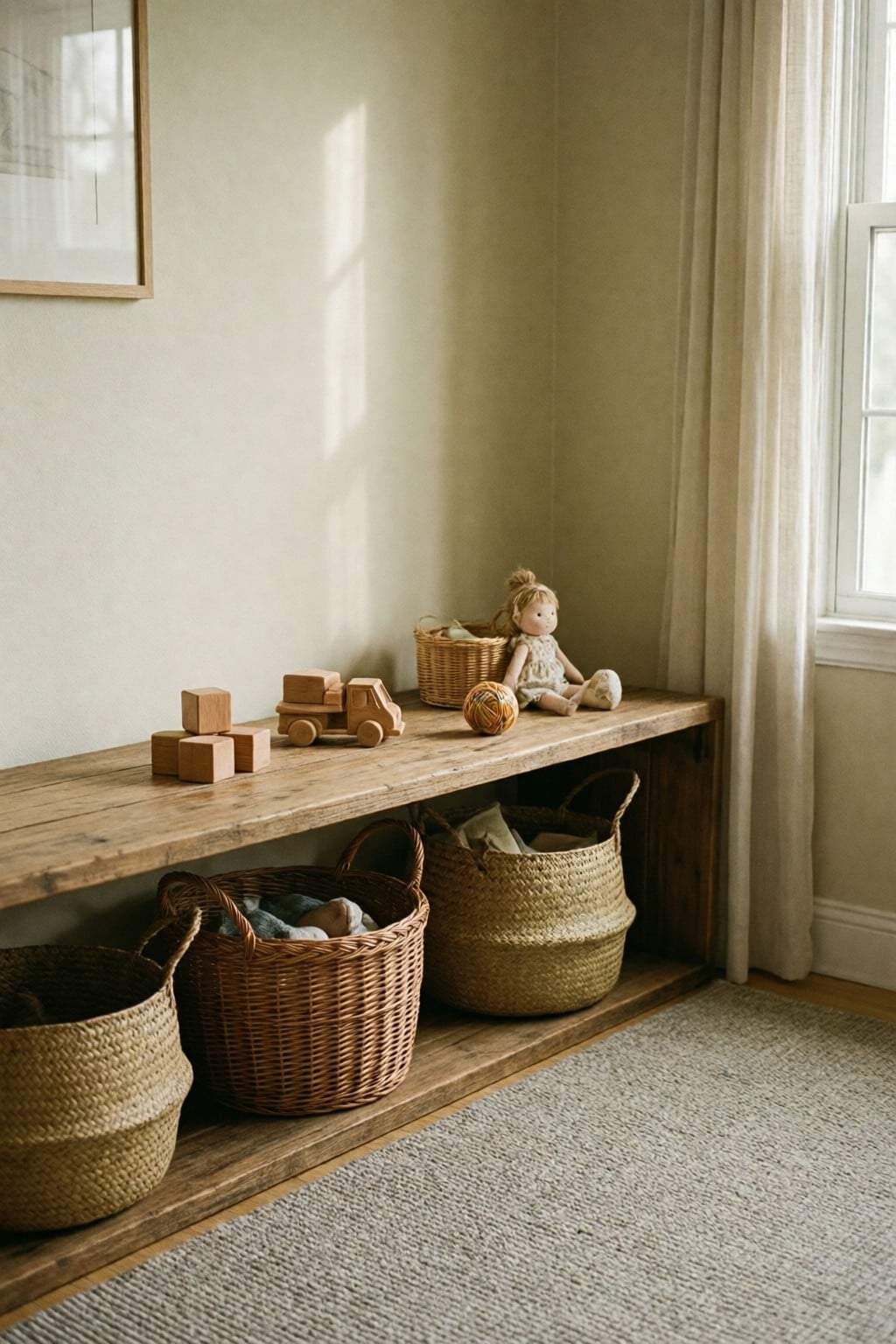
Fewer than you might think: keep a small set out at once and rotate the rest. There’s no set number for home, but in a University of Toledo lab study, toddlers played twice as long with their toys, and in more sophisticated ways, when four were out instead of 16. Keep out a mix of pretend, art, building and active-play toys, and when other kids come to play, KidsHealth suggests having plenty for everyone.
The living room floor is covered, the bins are overflowing, and your toddler still drifts from one thing to the next. Birthdays and holidays keep adding to the pile, so it’s a good time to ask: how many toys does a toddler need, really?
The short answer is to keep fewer out at once and save the rest for later. Below you’ll find what the much-shared University of Toledo study found (and what it didn’t), what child development groups suggest keeping out, and a toy rotation checklist. You can finish it in one afternoon without buying anything.
What did the Toledo toy study actually find?
Lead investigator Dr. Alexia Metz, an associate professor of occupational therapy at the University of Toledo, and her team studied 36 toddlers aged 18 to 30 months. Each child visited a playroom lab twice, once with just four toys and once with 16. Here’s what the university’s news release reports:
- Longer, richer play. With fewer toys, the toddlers played twice as long with the toys they had and in more sophisticated ways, Metz said.
- More creative play. Toddlers stayed with a toy longer. Instead of just stacking or tipping it, they began to hammer with it, feed it or hide it.
- More flitting with more toys. In the 16-toy room, many children played with 10 or more toys in the 15 minutes after they came in.
- A possible benefit, not a proven one. The release says having lots of toys may be distracting, and that the extra exploration seen with fewer toys may support motor and cognitive skills.
Metz’s advice to parents, from the same release, is simple:
“Save some for later and swap them out. If they have a chance to explore a few toys at a time, they might have a richer experience.”
What the study doesn’t tell you
This was a small lab study: 36 children, two visits each, in a playroom rather than a home. The release says it was due to appear in the journal Infant Behavior and Development. It doesn’t say how long the sessions lasted, and it gives no detailed numbers beyond “twice as long” and the count of 10 or more toys in the 16-toy room. The oldest children were 30 months, so it can’t tell us whether the findings hold for kids closer to 36 months.
The four-versus-16 setup was a lab comparison, not advice. Neither the Toledo release nor the ZERO TO THREE and KidsHealth pages linked here give a number of toys to keep out at home, a rotation schedule or a plan for siblings of different ages. Use the plan below as a starting point and adjust it to your child.
How many toys should a toddler have out at one time?
There’s no set number for home, but ZERO TO THREE gives a useful rule: variety over quantity. It recommends a mix of sensory, motor, cognitive and imaginative toys rather than filling a room with toys.
For about 18 to 36 months, its summary lists four helpful toy types: pretend-play props, art supplies, blocks or shape-sorters, and active play toys. Those make easy rotation categories. For example, putting out one or two toys from each category, with your toddler’s current favorite as one of them, gives you four to eight toys at once. That’s a small set that still covers every kind of play.
Count a set as one toy: a bin of blocks, a puzzle and its pieces, a basket of cars. If your toddler dumps everything and moves on fast, try the smaller end. If they settle in and play, you’ve probably found a good number for now.
Toy rotation categories for toddlers: what to keep out
Here’s how the four categories can look on a low shelf. The examples come from KidsHealth’s list of toys toddlers enjoy, with a few free extras from ZERO TO THREE’s toy tips.
| Category | Examples to rotate | Worth knowing |
|---|---|---|
| Pretend-play props | Dolls, animal or people figures, toy cars and trains | Simple props leave your toddler to make up the story. |
| Art supplies | Fat crayons or markers (plus paper) | You might keep these up high and bring them out when you can sit nearby. |
| Blocks and shape-sorters | Blocks, stacking and nesting toys, shape sorters, peg boards, simple puzzles | ZERO TO THREE says open-ended toys like wooden blocks spark imagination and help build problem-solving and logical thinking. Plastic bowls for filling and dumping belong here too. |
| Active play | Brightly colored balls; push, pull and riding toys | ZERO TO THREE notes that pillows work well for climbing and making caves. |
Busy boxes vs. battery toys: which ones stay out?
The sources seem to disagree here, but they’re talking about different toys. KidsHealth recommends mechanical toys like pop-up toys and busy boxes with knobs, buttons and levers. It says they build fine motor and problem-solving skills and teach cause and effect. That page is older (last reviewed in 2018), so weigh it alongside newer guidance.
ZERO TO THREE cautions that “the more a toy does, the less your child has to do.” It also warns that electronic toys can be dangerous, especially ones with small batteries. So here’s the practical split: a busy box your toddler has to push, turn and flip is hands-on play. A toy that lights up and sings by itself is doing the playing, which makes it a good first pick for the storage bin.
ZERO TO THREE’s safety basics apply to every toy: no small parts that could cause choking, non-toxic materials, no sharp edges, and an adult watching for mouthing. For toy safety guidance and recalls, check the U.S. government’s CPSC website, and ask your pediatrician about anything specific to your child.
Toy rotation starter checklist
You don’t need new shelves or matching bins for this. A few baskets or boxes you already have, a closet shelf and one nap time are enough to get started.
Keep out at once
- One or two pretend-play props, such as a doll, a few figures or a truck
- One or two art options, out only when you can supervise, such as fat crayons and paper
- One or two building or sorting toys, such as blocks, nesting cups or a simple puzzle
- One or two active-play toys, such as a ball, a push toy or a pile of pillows for a cave
- Your toddler’s current favorite, counted as one of the toys in its category
Set up and rotate the rest
- Gather everything in one spot. Bring toys from every room and the car to one floor or bed so you can see what you have.
- Do a quick safety check. Set aside anything broken, missing pieces, or with small parts or sharp edges, following ZERO TO THREE’s safety basics.
- Sort into the four categories. Anything that doesn’t fit, or that mostly plays by itself with lights and sounds, goes in a “maybe” pile.
- Choose what stays out. Use the list above, and keep the current favorite out no matter what.
- Store the rest out of sight. A closet shelf, a box under the bed or a high cabinet all work. Storing by category makes swaps quick.
- Give each toy a home. ZERO TO THREE suggests taping photos of toys to the basket or box where they belong and turning clean-up into a sorting game.
- Pick a swap day. There’s no set schedule, so choose one you’ll stick to, for example every week or two.
- Swap like for like. Trade a pretend toy for another pretend toy and a building toy for another building toy so the mix stays balanced.
- Leave what’s still loved. A toy that gets a lot of use stays out. A toy that sits untouched goes back.
- Keep a quick list. A note on your phone of what’s in storage helps you remember what’s there and notice what never gets missed.
How often should you rotate toys?
There’s no set schedule. Pick a rhythm you’ll actually keep (for example, every week or two) and let your toddler’s play tell you when to change it.
It may be time to swap when toys sit untouched or your toddler flits from one thing to the next. The Toledo researchers saw that flitting in the 16-toy room, where many children played with 10 or more toys in the 15 minutes after they came in. Putting fewer toys out is the first thing to try.
Asking for the same truck every morning isn’t a sign of boredom. KidsHealth says to expect a lot of repetition, because that’s how little ones master new skills and learn they have some control over their world. Leave the favorite out and rotate around it.
What about playdates, siblings, gifts and trips?
Playdates. Here, having more out is fine. KidsHealth says not to expect young toddlers to play together or to be thrilled about sharing, and suggests having plenty of toys for everyone. That advice is about sharing in group play. The Toledo findings are about how long and how richly a child played with the toys in front of them, so before friends come over, bring a few extras out of storage.
Siblings. With children of different ages, take this as a starting point. ZERO TO THREE flags small parts as a choking hazard, so keep an older child’s toys with small parts in their own space, out of your toddler’s reach. Shared favorites, like balls and blocks, can rotate together.
Holiday and birthday gifts. New toys don’t all have to come out at once. Open them, enjoy them, then put a few into storage for a slower month. If you’re still planning, the 4-gift rule for toddlers keeps the pile small, and a Christmas bucket list for toddlers trades some gifts for things to do together.
Trips. Your storage bin can double as a travel bag, since toys your toddler hasn’t seen in a while can feel new in the car. For more ideas, see these toddler toys for road trips.
What to skip (and what can wait)
- Skip buying more to fix boredom. Try a swap from storage first.
- Skip special rotation shelving. Boxes you already have and a closet shelf do the job.
- Skip buying what the kitchen already has. ZERO TO THREE says safe household items can be great learning tools, like plastic bowls for filling and dumping.
- Let toys that play by themselves wait. Toys that light up and play music on their own can go into storage first.
- Let the big decluttering decisions wait. Rotate first. After a while, you’ll see which toys never get missed.
You don’t need a perfect number or a picture-perfect playroom. Put out a handful of toys that cover the four kinds of play, store the rest, and swap when interest fades. If it feels too sparse, add one back. If it still feels like chaos, take one away. That’s the whole system, and you can set it up in an afternoon.
Frequently Asked Questions
How many toys should a toddler have out at one time?
There’s no set number for home. In a University of Toledo lab study, toddlers played twice as long with their toys when four were out instead of 16. One way to start is with one or two toys from each of four categories (pretend play, art, building and active play), four to eight in all, counting a current favorite as one of them. Then adjust to how your child plays.
How many toys does a 2 year old need?
Not many at one time. The Toledo study included toddlers aged 18 to 30 months, which covers many 2-year-olds, and they played longer and in more sophisticated ways with fewer toys. For about 18 to 36 months, ZERO TO THREE lists four helpful toy types: pretend-play props, art supplies, blocks or shape-sorters, and active play toys.
How many toys does a toddler really need?
There’s no set total, and owning more is fine as long as only a few are out at once. The mix matters more than the count: ZERO TO THREE recommends a mix of sensory, motor, cognitive and imaginative toys rather than a room full of toys. It also says safe household items, like plastic bowls and pillows, can be great learning tools.
What is a toy rotation system?
Toy rotation means keeping a small set of toys out, storing the rest out of sight, and swapping some back in now and then. It follows the advice of Toledo researcher Dr. Alexia Metz: “Save some for later and swap them out.” Sorting toys into categories and swapping like for like keeps the mix balanced.
What are good toy rotation categories for toddlers?
ZERO TO THREE’s four toy types for about 18 to 36 months make easy categories: pretend-play props, art supplies, blocks or shape-sorters, and active play toys. Keep a little from each out and store the rest by category. Then each swap is a quick trade of like for like.
How often should you rotate toddler toys?
There’s no set schedule, so pick a rhythm you’ll keep, for example every week or two. Rotate out toys that sit untouched, and keep favorites out. KidsHealth says repetition is how toddlers master new skills, so playing with the same toy every day isn’t a problem.
📱 Baby Days: the newborn log that remembers for you
Feeds, sleep, and diapers logged in two taps — and every caregiver stays on the same page. Free on iPhone and Android. See all our apps →